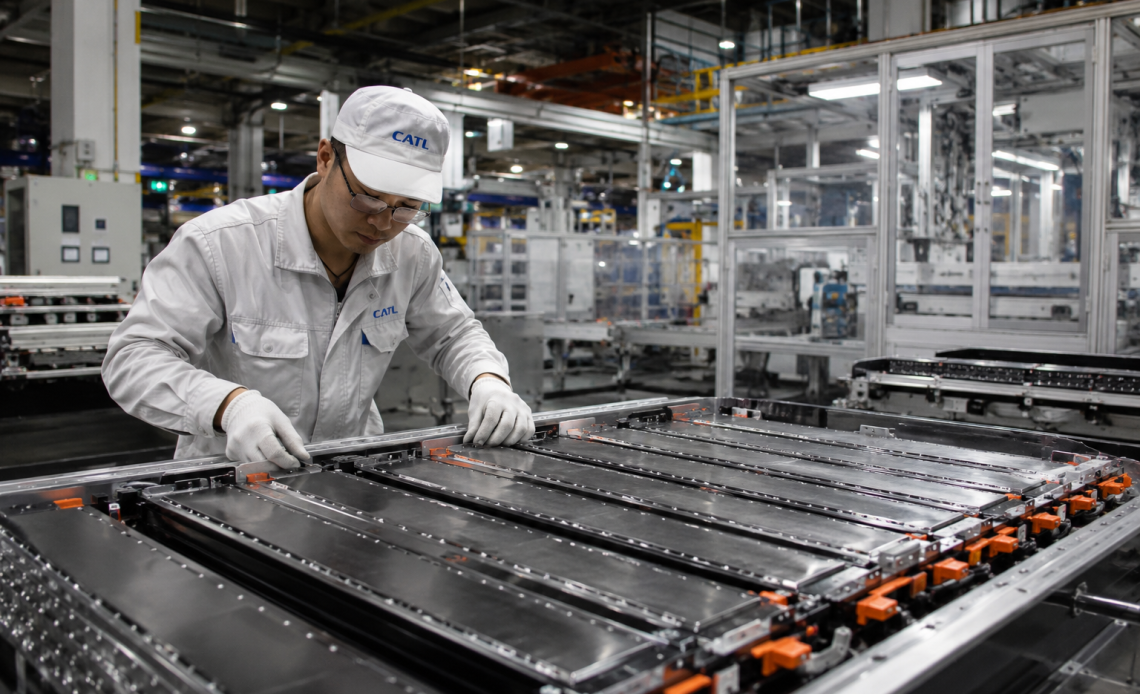
China’s CATL, the world’s largest battery manufacturer, expects energy storage to account for half of its global sales by 2030, up from approximately 25% at present, according to a company executive.
Kevin Tang, CATL’s Director of Energy Storage Systems for Europe, said the energy storage segment has grown significantly over the past five years.
Speaking to Reuters on the sidelines of the International Photovoltaic Power Generation and Smart Energy Conference & Exhibition in Shanghai, Tang noted that energy storage represented only 2% of the company’s battery sales five years ago.
Rising demand driven by renewable energy growth
CATL was founded in 2011 and initially focused on manufacturing lithium-ion batteries for electric vehicles.
Electric vehicle batteries currently account for around three-quarters of the company’s sales.
However, Tang said the growing deployment of renewable energy sources is creating increased demand for battery storage systems.
According to him, energy storage plays a crucial role in supporting renewable power generation, which can be intermittent in nature.
The shift highlights the expanding role of battery technology beyond electric vehicles as countries and companies seek solutions to improve grid stability and integrate larger volumes of renewable power into energy systems.
Europe emerges as a key market
Tang identified Europe as CATL’s third-largest energy storage market after China and the United States.
According to him, customers across Europe are investing in different types of storage projects depending on local grid requirements.
These include renewable energy projects paired with storage systems as well as grid-side storage facilities designed to address congestion issues within power networks.
CATL has expanded its manufacturing footprint in Europe through battery plants in Germany and Hungary.
The company has also begun construction of a new facility in Spain through a joint venture with automaker Stellantis.
Profitability remains a challenge
While discussing the European market, Tang said the energy storage sector has not faced the same level of pressure as the automotive industry regarding stricter local sourcing requirements aimed at protecting domestic industries.
Despite growing demand, profitability remains a challenge for the broader energy storage industry, he said.
The economics of large-scale storage projects continue to be an important consideration for developers and manufacturers as the sector expands.
Focus on safety and supply chain stability
CATL announced this week that it will invest 3 billion yuan in an energy storage testing centre.
The facility will be used to simulate power grids and investigate the causes of energy storage-related fires and explosions, issues that Tang described as major concerns among customers.
The company is also monitoring rising raw material costs.
Tang said prices of materials such as lithium, copper, and aluminium have increased following the US-Israel war with Iran, creating challenges for energy storage manufacturers.
However, he expressed confidence that costs would decline over the longer term as the industry supply chain matures.
To strengthen supply chain control, CATL operates lithium mining activities in southern China.
Tang also said the company runs the world’s largest battery recycling plant, enabling the recovery of key raw materials used in battery production.
The post CATL expects energy storage to account for half of global sales by 2030 appeared first on Invezz