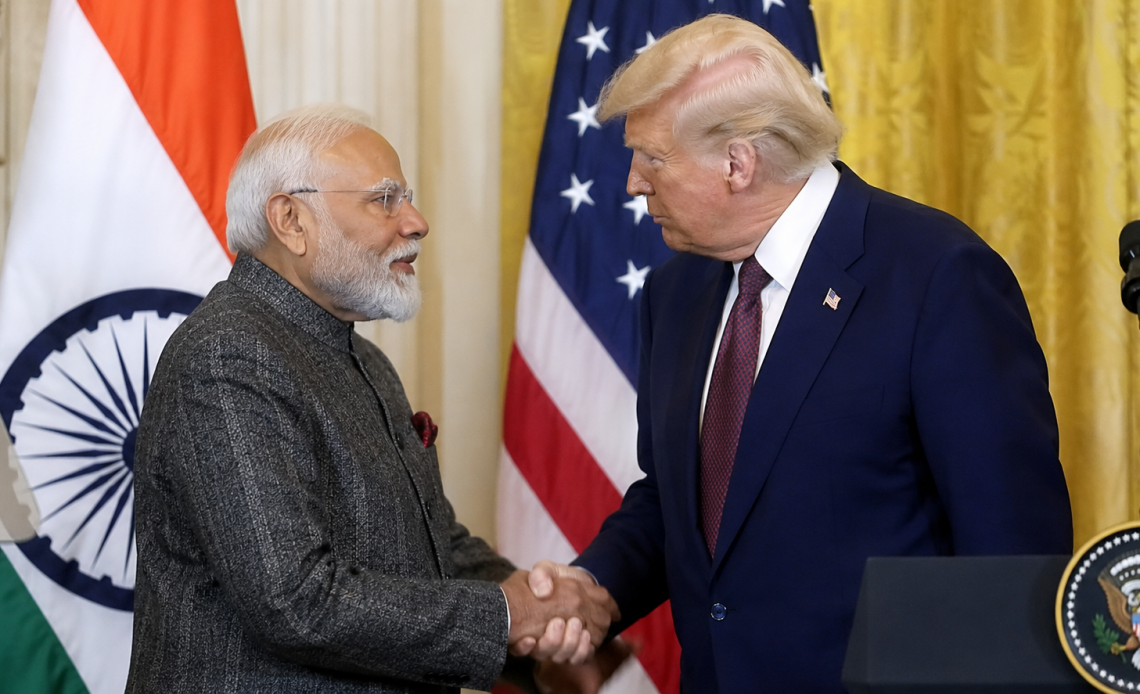
The United States has proposed an additional 12.5% tariff on imports from India.
The move comes as part of ongoing trade discussions in New Delhi between Indian officials and a US delegation led by Assistant US Trade Representative Brendan Lynch.
The proposal emerged during the second of three days of bilateral talks.
It signals potential friction in negotiations that are already focused on broader trade terms between the two countries.
According to the US Trade Representative’s office, the tariff proposal is linked to concerns over forced labour-related import restrictions.
The office stated that India is among 60 economies that have not taken sufficient steps to curb imports associated with forced labour.
USTR report raises compliance concerns
In a detailed 92-page report released on Tuesday, the US Trade Representative’s office criticised India’s trade enforcement framework.
The report stated, “India has failed to impose and effectively enforce a forced labour import prohibition,” the office said in a 92-page report on Tuesday that called the South Asian nation’s policies unreasonable and a burden on US commerce.
The report placed India among 54 economies that reportedly lack a forced-labour import prohibition, thereby subjecting them to a higher proposed tariff level.
It also identified six other economies, including Canada, Ecuador, the European Union, Indonesia, Mexico, and Pakistan, which have such prohibitions but are still subject to a lower proposed tariff of 10% due to enforcement-related concerns.
US officials defend the proposal
US Trade Representative Jamieson Greer defended the move, arguing that global trade conditions remain uneven due to insufficient enforcement against goods linked to forced labour.
“The failure of our most important trading partners to address the importation of goods made with forced labour is unacceptable,” US Trade Representative Jamieson Greer said.
He further added, “this creates a dynamic where American workers are forced to compete globally on an unlevel playing field.”
The comments highlight Washington’s position that enforcement gaps in trading partner countries may distort competition for domestic producers.
Section 301 framework and broader trade context
The tariff proposal follows a Section 301 unfair trade practices investigation.
This action is part of efforts under the current US administration to reintroduce emergency tariffs that were previously struck down by the Supreme Court in February.
The measure is being positioned as part of a broader trade enforcement strategy aimed at addressing alleged unfair global practices linked to labour standards.
India’s response and ongoing discussions
India’s commerce ministry did not immediately respond to a request for comment on the proposal.
However, according to an Indian government source cited in the report, New Delhi is expected to raise the Section 301 investigation during talks with the US delegation.
India is also expected to seek tariff relief as part of the wider bilateral trade negotiations.
Supply chain concerns highlighted
The US Trade Representative’s report also raised concerns regarding global supply chains.
It identified India as an intermediary in cotton supply chains that may be linked to Chinese forced-labour inputs.
This additional reference adds another layer to the ongoing discussions, potentially broadening the scope of trade-related scrutiny between the two countries.
The post What does the proposed tariff mean for the India-US trade pact? appeared first on Invezz