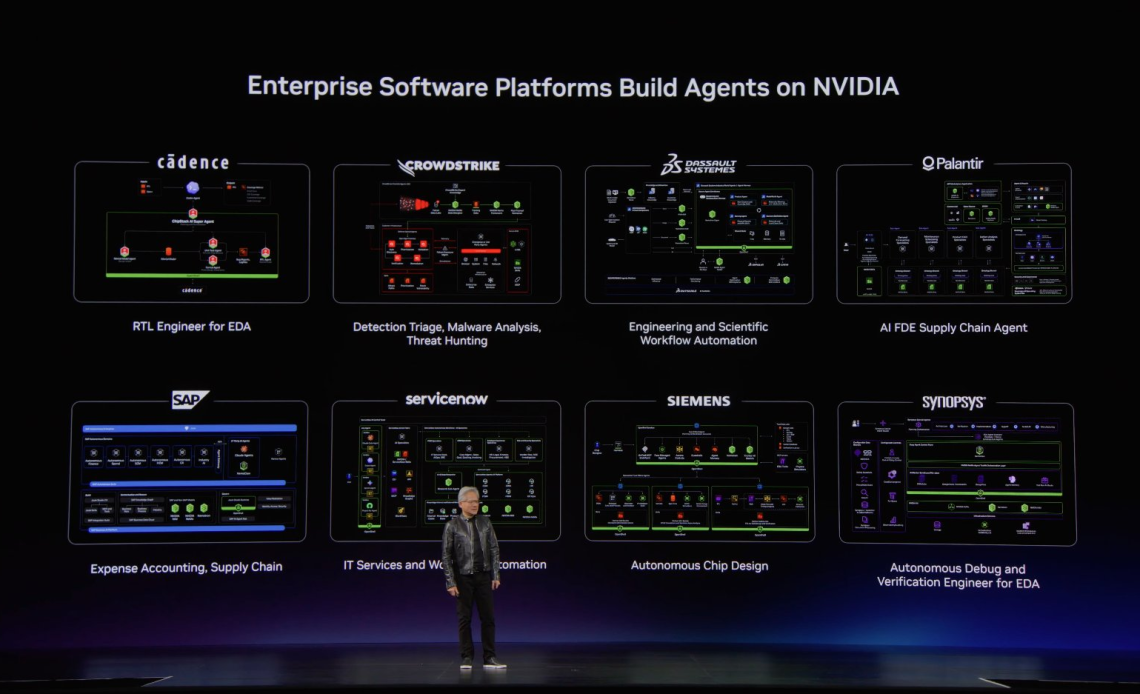
A recovery in software stocks accelerated on Monday after Nvidia chief executive Jensen Huang pushed back against concerns that artificial intelligence could undermine the software industry.
The comments provided a fresh tailwind to a sector that had already begun rebounding as investors bought the dip following months of heavy selling.
ServiceNow (NOW) rose 10% in premarket trading, while IBM gained around 11% and Salesforce climbed more than 6%.
The gains built on Friday’s advance, when ServiceNow jumped more than 14%, IBM rose over 12%, and Salesforce added roughly 8.5%.
Nvidia chief offers support to software sector
Speaking at the Computex conference in Taiwan, Huang directly challenged a narrative that has weighed on software valuations since the emergence of agentic AI systems.
“A lot of people have said, ‘Jensen, AI is coming. Agentic AI is coming. Therefore, all of the software companies are going to go out of business.’ I said it’s exactly the opposite,” Huang said during his keynote presentation.
Agentic AI refers to systems capable of performing tasks and workflows with minimal human intervention.
While some investors have worried that such systems could replace existing software applications, Huang argued that the growing use of AI agents would actually increase demand for software tools.
“Because there are going to be many agents doing work, they’re going to be using more tools than ever,” he said.
“This is actually an incredible time to be a software company, but the software has to be presented to the agent in a way that the agent can use it.”
Huang also rejected suggestions that AI would reduce hiring across the software industry.
“The number of engineers, software engineers, is actually increasing. People talk about AI reducing jobs — complete nonsense. It’s causing more software engineers to be hired,” he said.
Investors return after steep selloff
Software stocks were among the biggest casualties of the AI-driven market rotation earlier this year as investors shifted capital toward semiconductor and infrastructure companies expected to benefit directly from surging AI spending.
The concern was that AI assistants and autonomous agents could eventually replace certain software functions, reducing demand for traditional enterprise software platforms.
Recent trading, however, suggests investors are reassessing those assumptions.
ServiceNow shares have climbed roughly 36% over the past month, while IBM has gained about 28% during the same period.
Despite the rebound, many software names remain flat or negative for the year.
The broader software sector has also shown signs of recovery.
The iShares Expanded Tech-Software Sector ETF (IGV), while still down around 4% in 2026, has gained approximately 17% over the past month.
The renewed strength comes as market participants increasingly focus on how software companies could benefit from AI adoption rather than be displaced by it.
AI shifts from threat to opportunity
Huang’s comments coincided with Nvidia’s unveiling of a new RTX Spark PC chip designed to bring AI capabilities directly to laptops and desktop computers.
The chip is part of a broader effort between Nvidia and Microsoft to reshape personal computing around AI-driven applications.
According to Huang, the initiative follows three years of collaboration aimed at “reinventing the PC” for the AI era.
Industry observers believe local AI processing could accelerate the adoption of AI agents and create new opportunities for software vendors whose products can integrate with those systems.
That shift in sentiment has increasingly influenced Wall Street’s outlook on enterprise software companies.
Analysts see long-term winners emerging
Recent analyst actions suggest growing confidence in select software names positioned to benefit from the rise of agentic AI.
Bank of America reinstated coverage of ServiceNow with a Buy rating and a $130 price target on May 18, arguing that the company’s workflow platform could become a central orchestration layer for autonomous AI agents.
The brokerage said ServiceNow’s deep integration across IT, employee, and customer workflows leaves it well positioned to serve as a “control tower” for enterprise AI operations.
Bank of America’s thesis is based on the belief that platforms capable of coordinating AI-driven actions across organizations will emerge as key beneficiaries of the next phase of AI adoption.
IBM has also attracted positive attention from analysts.
Barclays recently initiated coverage of the company with an Overweight rating and a $350 price target, implying significant upside from recent levels.
According to analyst Raimo Lenschow, IBM’s software business enjoys a highly stable customer base concentrated in large regulated industries where switching costs remain high.
Barclays noted that nearly half of IBM’s revenue and a majority of its profits come from software, with that contribution expected to grow as software continues to outperform other segments of the business.
The latest rally suggests investors may be warming to the view that software companies will play a critical role in the AI economy, not as victims of technological disruption but as essential infrastructure providers helping autonomous systems operate at scale.
The post NOW, IBM, other software stocks surge as Huang eases AI fears appeared first on Invezz